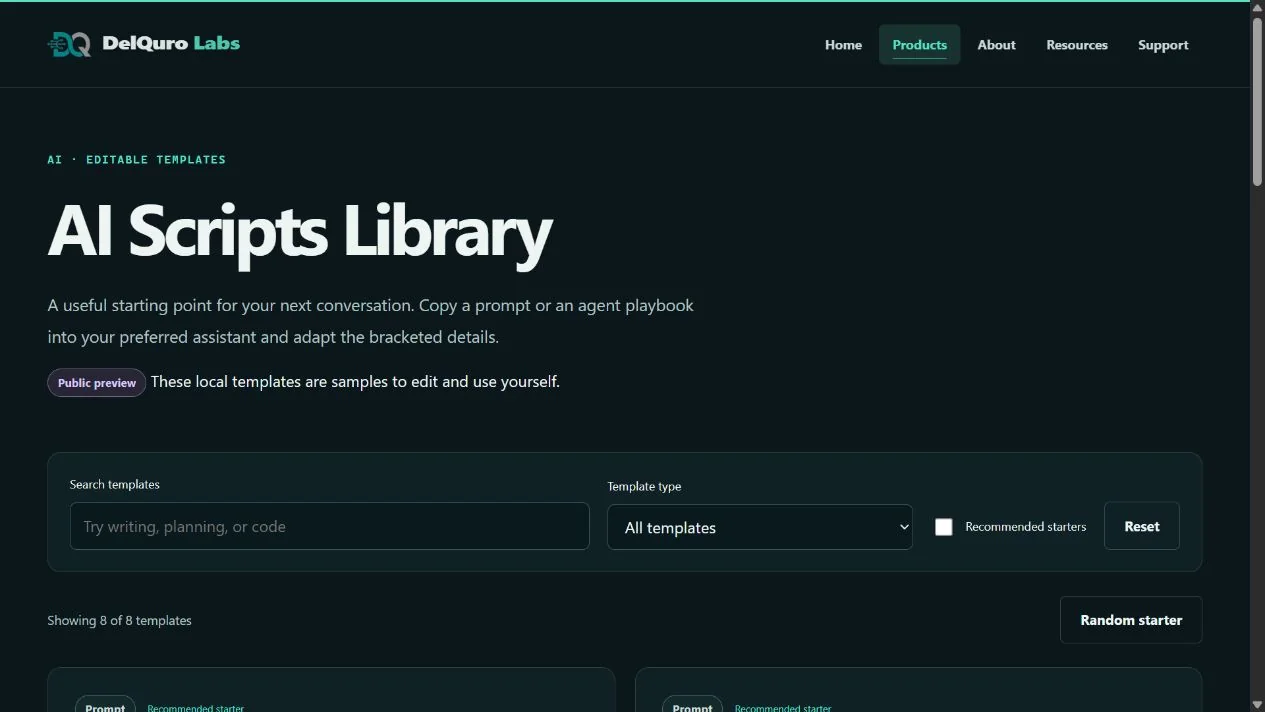
A useful starting point for your next conversation. Copy a prompt or an agent playbook into your preferred assistant and adapt the bracketed details.
Public preview These local templates are samples to edit and use yourself.
All eight templates are shown below.
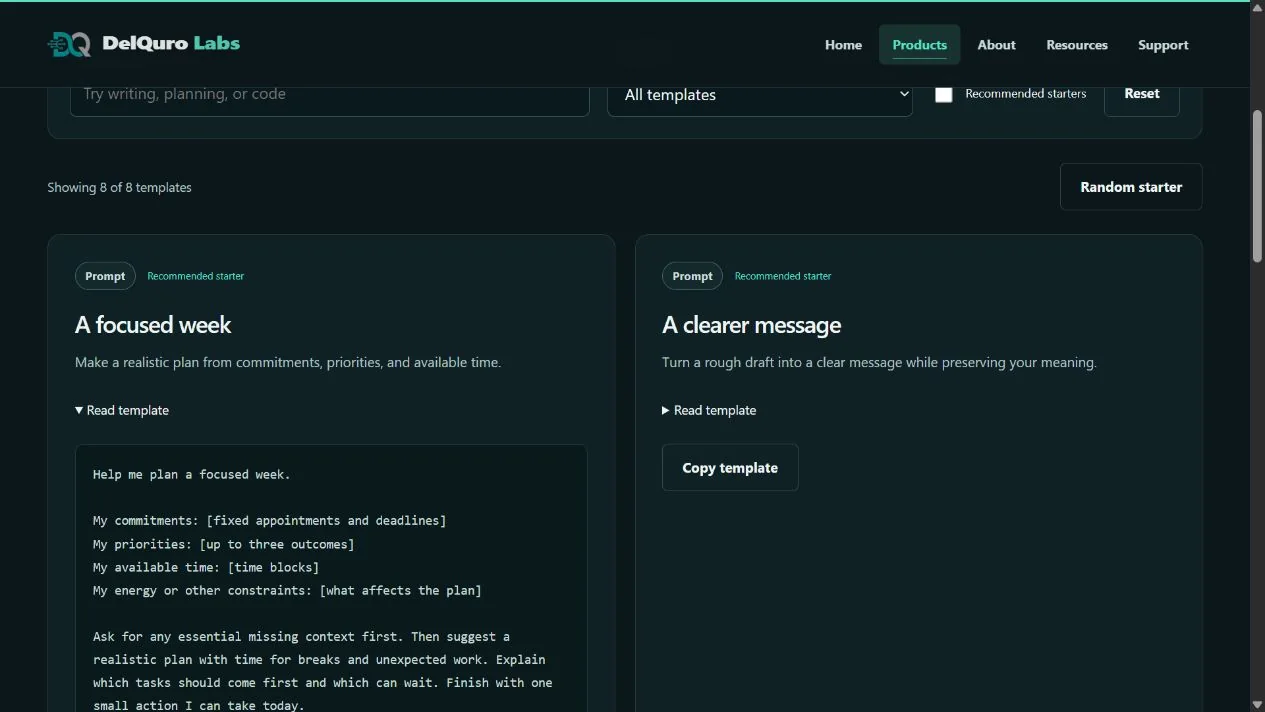
PromptRecommended starter
A focused week
Make a realistic plan from commitments, priorities, and available time.
Read template: A focused week
Help me plan a focused week.

My commitments: [fixed appointments and deadlines]
My priorities: [up to three outcomes]
My available time: [time blocks]
My energy or other constraints: [what affects the plan]

Ask for any essential missing context first. Then suggest a realistic plan with time for breaks and unexpected work. Explain which tasks should come first and which can wait. Finish with one small action I can take today.
PromptRecommended starter
A clearer message
Turn a rough draft into a clear message while preserving your meaning.
Read template: A clearer message
Help me make this message easier to understand.

Audience: [who will read it]
Purpose: [what I want them to know or do]
Tone: [warm, direct, formal, or another preference]
Draft: [paste my text]

Preserve the meaning and any necessary detail. Do not add facts, promises, or commitments I did not supply. Ask if an important point is ambiguous. Provide one polished version and briefly explain any meaningful changes.
Prompt
Notes into next steps
Separate decisions, open questions, and practical actions from messy notes.
Read template: Notes into next steps
Organize these notes into a useful next-step list.

Notes: [paste notes]
Context: [what the notes are about]
People involved: [names or roles, if relevant]

Identify decisions already made, open questions, and proposed actions. Keep uncertain items clearly marked as uncertain. Assign an owner or deadline only when the notes support it. End with the three most useful next steps and any clarification needed.
Prompt
Explore an idea
Find the smallest useful version of an idea before expanding its scope.
Read template: Explore an idea
Help me explore this idea.

Idea: [describe it]
Who it could help: [intended audience]
Problem it addresses: [the everyday need]
Constraints: [time, budget, tools, or other limits]

Ask a few focused questions if needed. Describe the smallest useful version, the assumptions it depends on, and a simple way to learn whether it helps. Offer two alternatives only if they materially improve the decision. Keep the next step small and concrete.
Agent playbookRecommended starter
Research with evidence
Use a repeatable process to answer a question and keep evidence separate from assumptions.
Read template: Research with evidence
Follow this research playbook.

Question: [what I need to understand]
Scope: [place, time period, audience, and other boundaries]
Required output: [brief answer, comparison, or report]

1. Confirm the question and identify missing context.
2. Break the question into a few answerable parts.
3. If browsing or source access is available, gather relevant primary sources and note their dates. If access is unavailable, explain what evidence is still needed.
4. Separate established facts, source disagreements, and your own inferences.
5. Give a concise answer with links for sourced claims and specific limits on the conclusion.
6. Suggest the next useful check only if the evidence leaves an important question unresolved.

Do not invent sources, quotations, or verification results.
Agent playbookRecommended starter
Review a code change
Review behavior and meaningful risks before proposing a focused correction.
Read template: Review a code change
Follow this code-review playbook.

Change or files: [provide the diff or relevant code]
Intended behavior: [what the change should do]
Project context: [language, framework, and important conventions]

1. Read the surrounding code and project instructions.
2. Trace the changed behavior and its callers.
3. Look for concrete regressions, missing edge cases, and inconsistencies with the intended behavior.
4. Verify concerns with the available code or tests. Distinguish a confirmed issue from an unanswered question.
5. Report actionable findings with file locations, the triggering condition, and the likely effect.
6. Recommend the smallest correction and an appropriate verification step.

Do not edit files unless I ask you to implement the correction. Do not report tests as passed unless they were actually run.
Agent playbook
Review an interface
Check keyboard access, readable content, touch use, and motion before refining an interface.
Read template: Review an interface
Follow this interface-review playbook.

Interface: [URL, screenshots, or code]
Main user task: [what the person needs to accomplish]
Constraints: [supported devices and other requirements]

1. Understand the task and the available evidence.
2. Check headings, labels, link purpose, and error messages.
3. When an interactive browser is available, try keyboard navigation, visible focus, touch-sized controls, zoom, and reduced-motion preferences.
4. Check that important content remains understandable when animation or scripting is unavailable.
5. Report concrete obstacles with their effect on the user and a practical correction.
6. Clearly state what could not be tested.

Do not claim a full accessibility audit from screenshots alone.
Agent playbook
Keep documentation useful
Bring a guide into line with the current source while preserving its purpose.
Read template: Keep documentation useful
Follow this documentation-update playbook.

Document: [paste the guide or provide its path]
Source of truth: [current code, approved specification, or verified behavior]
Audience: [who will use the guide]

1. Read the document and its source of truth.
2. Identify outdated steps, missing prerequisites, broken references, and unclear wording.
3. Resolve routine wording choices while keeping the document's purpose and audience in mind.
4. Ask about contradictions that the available evidence cannot resolve.
5. Propose a focused update with concrete steps and examples.
6. Check that every command, link, and claimed behavior has supporting evidence.

Do not invent product features or present an unverified procedure as tested.
No templates found.
Try another word or a different template type.
App screenshot
Take a closer look.
Browse the screens. Select an image to see it larger.
Browse prompt and agent templatesRead a starting-point template
Screenshots of this site’s editable template library. Templates do not run an AI service. Captured 2026-10-18.
Public preview
AI Scripts Library
A browser-based prototype with local templates. It does not run an AI service or submit prompts to a provider.